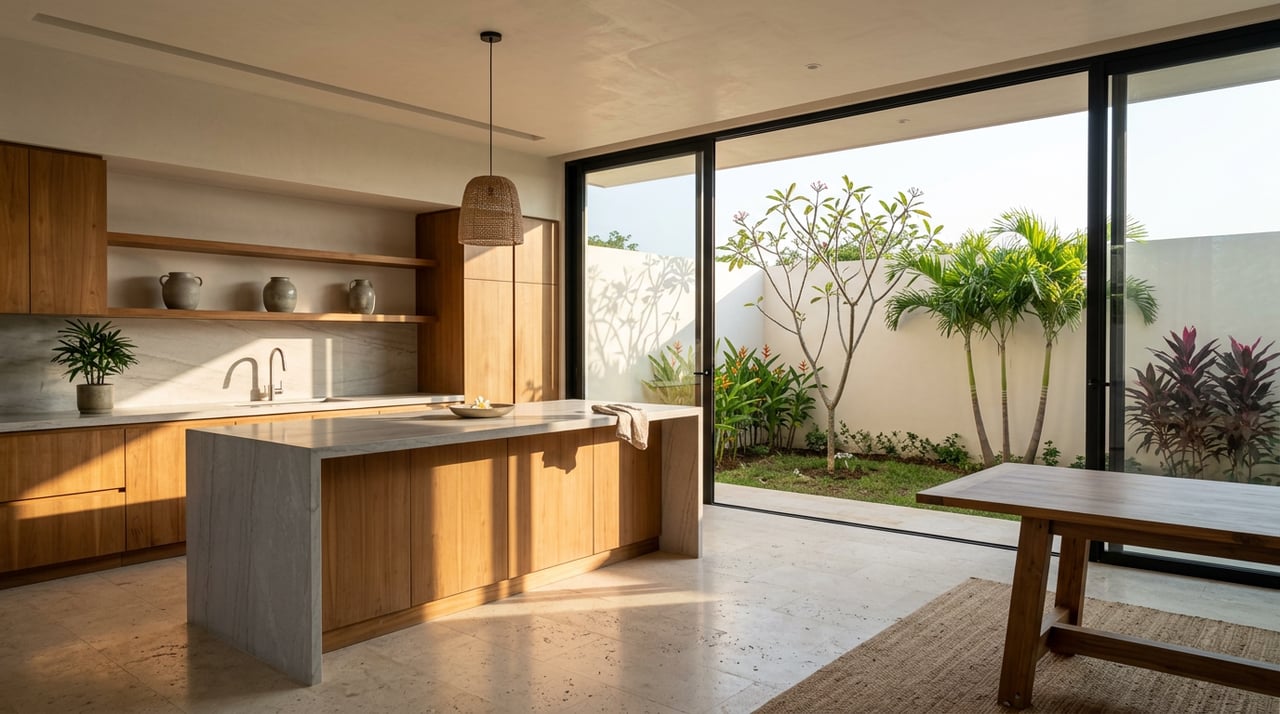
Two three-bedroom homes go up for sale in Princeville the same week. Same square footage, same builder-grade lanai, similar mountain glimpse from the primary suite. One lists for a price that makes sense against recent comps. The other lists nearly a third higher, and it sells faster.
The difference usually has nothing to do with the kitchen counters. It comes down to a boundary drawn on a county zoning map: the Visitor Destination Area line. Whether a parcel sits on one side of that line or the other decides whether an owner can legally rent it out by the night, and that single fact reshapes who is bidding on the house, how a lender underwrites it, and what an appraiser is willing to call a comparable sale.
If you are comparing Princeville to other North Shore pockets and wondering why the numbers don't line up the way square footage alone would predict, this is the mechanism to understand before you write an offer.
The three letters that move the price
Kauai County designates specific pockets of the island as Visitor Destination Areas, or VDAs, where nightly vacation rentals are permitted by right rather than by special exception. Princeville is one of them. So are parts of Poipu and sections of Kapaa, with a small VDA carve-out in Waimea. Everywhere else on the island, a single-family home is treated as long-term housing stock, restricted to rentals of six months or more.
That distinction is enforced through Kauai County Ordinance 904, which governs how transient vacation rental permits are issued and defines the dwelling uses that qualify. Being inside a VDA does not automatically clear every unit for nightly guests. Buyers still need to confirm that the specific building or HOA hasn't layered its own restrictions on top of what the county allows. A condo project inside the VDA can still say no to short-term rentals in its own governing documents.
That's the part a median price can't tell you. The zoning line sets the ceiling on what's possible. The HOA and the building's own history set what's actually true for the unit you're looking at.
A permit ceiling, not a want ad
Outside the VDA, the path to legal nightly rental is narrower and it has been closed for a while. The county stopped issuing new non-conforming use permits for short-term rentals outside VDA zones after March 30, 2009. Anything still operating today outside a VDA is doing so on a grandfathered Transient Vacation Non-Conforming permit, and there are only around 438 of those left on the entire island. No new ones are coming.
That scarcity cuts both ways. A grandfathered TVNC property, when one actually comes to market, can command its own premium precisely because there is no legal way to create another one. But it is also fragile. These permits typically don't transfer freely, can carry renewal deadlines, and can be lost through a lapse or a change in use. A buyer who assumes "it's always been rented out here" is proof of compliance is taking on real risk. Historic operation is not the same as a current, valid permit.
The county has gotten serious about the difference. Illegal vacation rentals on Kauai fell from roughly 1,500 in 2017 to fewer than 50 by 2024, a sign that unpermitted nightly rentals outside VDA boundaries are not a workaround so much as an expiring loophole.
A street that proves the point
Princeville's Aloalii Drive is a good illustration of how granular this gets. Due to the specific zoning and HOA guidelines that apply to homes on that street, owners can rent for stretches of 30 days or more, a middle tier that sits between a nightly vacation rental and a standard long-term lease. That makes it a genuine option for snowbirds and seasonal residents who want flexibility without operating a full short-term rental business.
The point isn't that Aloalii Drive is special because it's pretty. It's special because its rules are different from the block next to it. Princeville is not one zoning story. It's dozens of parcel-level stories that happen to share a name and a bluff.
| Category | Nightly rental legal? | New permits available? | Typical buyer profile |
|---|---|---|---|
| Inside VDA, HOA-approved | Yes, with registration | Yes | Investors and second-home buyers seeking rental income |
| Outside VDA, grandfathered TVNC | Yes, until permit lapses | No new permits since 2009 | Buyers comfortable with legacy-permit risk |
| Outside VDA, no permit | No, 180-day minimum only | No | Primary residents, long-term landlords |
What this is doing to today's numbers
As of late May 2026, the median listing price for a Princeville home stood at roughly $1.42 million, working out to about $790 per square foot. That figure sits well above the countywide median, and the VDA designation is a large part of why. A home that can legally generate nightly income gets appraised and financed differently than one that can't, even when the two are a short drive apart.
The island's broader market gives a useful contrast. Countywide sales activity in June 2026 showed home sales down 29 percent and condo sales down 13 percent compared with the same month a year earlier. More telling is what happened to time on market: single-family home days on market compressed to 25 days, down 24 percent from the year before, while condo days on market stretched to 153 days, up 350 percent.
That gap is worth sitting with. A slower condo market islandwide tracks with buyers taking longer to underwrite exactly the kind of compliance questions this piece has been walking through: is the unit's rental status actually current, does the HOA still allow it, is the permit tied to the seller or to the property. Single-family buyers, many of them owner-occupants rather than rental operators, aren't running that same diligence gauntlet, and they're moving faster because of it.
The carrying-cost layer that follows the zoning line
Legal rental status also isn't the last cost a buyer needs to model. Every Princeville property owner pays dues to the Princeville Community Association, which funds roads, common landscaping, and security. Buy into a condo or a sub-development on top of that, and a second layer of sub-association fees applies. Across Kauai HOA and planned-development projects generally, monthly dues run somewhere between $500 and $2,200 depending on the project, and that range moves with the amenities and insurance the association is carrying.
Anyone planning to operate a legal rental also needs to register for Hawaii's Transient Accommodations Tax and General Excise Tax. A property's tax license can be verified directly through the state's ehawaii.gov license search portal, and real property tax classifications, which differ for owner-occupied versus non-owner-occupied and vacation rental use, are published on Kauai County's real property tax rate page. Getting the classification wrong doesn't just cost money. It can flag a rental that isn't actually compliant.
What to verify before you write an offer
- Confirm VDA status for the specific parcel with Kauai County Planning, not just the general area
- Request written documentation of any TVR or TVNC permit, and ask whether it transfers with the sale or is tied to the current owner
- Pull the HOA's CC&Rs and house rules directly, since they can restrict rentals more tightly than county zoning allows
- Ask for TAT and GET filing history if the seller has been operating a rental
- Get a written statement from the HOA confirming current rental rules before you remove contingencies
A few questions worth asking directly
Does buying inside the VDA guarantee I can rent nightly? No. The VDA makes it legally possible at the county level, but the specific HOA or condo association can still prohibit or restrict short-term rentals in its own governing documents.
What happens if a grandfathered TVNC permit lapses? It typically cannot be replaced. The county has not issued new non-conforming permits outside VDA zones since March 2009, so a lapsed permit generally means the property reverts to standard long-term rental rules.
Is a home's rental history proof that it's currently compliant? No. Past operation, even for years, is not documentation of a valid current permit or registration. Ask for the paperwork itself.
Princeville rewards buyers who read the fine print as carefully as they read the view. If you're comparing what a similar-looking home actually costs to own here versus elsewhere on the North Shore, the Andrews Collection team has spent years tracing these zoning lines parcel by parcel. Contact Us when you're ready to look at what a specific property can and can't legally do, before the price tag has to make sense of it for you.
